24 August 2020
Lens:
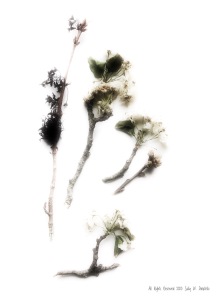
Dried Morsels of Nature Series, #1; All Rights Reserved 2020 Sally W. Donatello
Click onto image to enlarge. Let me know your response to this image. Prints are available upon request.
Pens:
This summer I upcycled multiple small opaque plastic bottles (5” high x 2” wide), stripping them of their outer cover and converting them into small white flower containers. I place single flowers in them, arrange them in groups or singular displays. They’ve become symbolic vessels of creative recycling during lockdown, isolation, when I see the world as different as it is the same.
The bright faces decorate indoor and even outdoors spaces. My wildflower gardens provide an abundance of choices. Bright cheery colors line the edges of the landing outside my kitchen, connecting my inner world to the outdoors. But a second ritual of past decades emerged with vigor: collecting leaves, flowers, buds, herbs, seeds and samples of the seasons to dry. I’ve been drying flowers for decades. But during this bizarrely strange and eerie time, it’s become a semi-obsession, observing and rescuing a small bit of nature and preserving her extraordinary brilliance.
That brilliance (in the sense of magical emotional comfort and healing) is a metaphor for life and death that has transpired over the last six months. Each element of nature’s wonder becomes a memorial to this time of upheaval and constant uncertainty. Each time my attention is mesmerized by a sighting of a fallen leaf, a floret, a part of the wild that begs to enter my small world, I must preserve that discovery. And that discovery is infinite, and becomes a lifeline to instantly save me for a second or more.
The floor of my living room is lined with panels of black or white foam core. A spring and summer’s worth of samplings rest as they change their appearance, constantly pulling my attention to their continual metamorphosis.
One singular flower can become a storyboard, a narrative of the life cycle. As I arrange them on separate panels, they have become visual poems dedicated to a horrific and strange and troubling time in human history. These tiny visual reminders of the last six months are tangible proof of time’s erasure—time that has slipped through my memory with questions about its sudden evaporation, as though it never existed.
But these samples of nature also are symbolic vessels of omnipresence and omnificence in the natural world. Mother Nature brings a singular powerful strength into my days; she gives me grace and beauty and pause to consider the positive in the negative spaces of daily existence. The moments of sheer internal bliss that surface from this awareness always result in awe and wonder.
Each flower plucked, each leaf rescued is a reminder. Each morsel has its hidden charms. Each small life brings gestures of reflexive remembrance, and simultaneously builds memories anew. What I receive from nature’s bounty and offerings sustains my emotional well being, She keeps me afloat, a true lifeline.
My adoration overflows with reverence. That feeling is a thread that sustains one day into the next. And so as I tend my gardens, I tend my swollen heart. As I care and maintain my gardens, I give thanks for the decades of immersion into stewardship of the land. The gifts of nature are boundless and my gratitude is evergreen.
Nature influences me, helping me articulate who I am. She shields me, and protects me from the world—a world that struggles between an apocalyptic meltdown, and renewal of the democratic country our founders promised.
***********************************************************************************
In the Lens section is an image that demonstrates some of nature’s gifts over the last six months. I purposely gave it a shimmering patina, because even in their reduction of full life each morsel of nature continues to reinvent itself in our eyes and their place in the natural world.
************************************************************************************
“Injustice anywhere is a threat to justice everywhere.” — Dr. Martin Luther King, Jr.




 Lens and Pens by Sally